

International Interdependence Day: April 2, 2026—A Holiday for the World We Deserve

Give us something to celebrate and we show up: ready to wave flags, feast, post memories, light candles, or gather in the spirit of something—remembrance, reflection, pause, listening, simply being.
Across the world, declarations of independence are celebrated with national pride. But what are we really celebrating when that independence came at the cost of others’ erasure?
Every year, we celebrate independence—the story of standing alone, breaking away, surviving by ourselves. But the truth is simpler and older than any flag: none of us survive alone. Not as individuals. Not as nations. Not as a species.
That’s why something different is needed—something the world is already hungry for, even if we don’t yet have the language for it.
International Interdependence Day.
A day when the whole world pauses to remember these truths:
We are not owned by any system.
We belong to each other.
We always have the power to say ‘no’.
Why This Holiday
International Interdependence Day is a clear message to anyone in power—governments, corporations, institutions—that people are not property. We are not owned by markets, borders, or the idea that we must compete to survive.
It is also a reminder to the people—that we shape society. Not the politicians we hire. Not the extractive elite. Not the systems that benefit from our division.
We are the many, and we decide what kind of world we live in.
A Peaceful Act of Global Refusal
This day is more than a holiday. It is a peaceful, coordinated act of civil disobedience.
By pausing together on the same day, people everywhere practice saying “no” to harmful systems without risking their safety. No marches required. No confrontations. No fear of retaliation.
The pause itself becomes the message:
We can withdraw our compliance from domination gently, safely, and together. We’ve done it before—during lockdown, the whole world stopped. We can manage a single day.
Empire taught us that obedience keeps the world intact. But one shared pause reveals the lie: the world goes on. That pause becomes proof that we can reclaim ourselves and each other without collapse—a ritual of remembering our past, our direction, and our power. And each year, it reminds us where we come from, what the old world extracted from us, what we’re reaching toward now, and that life keeps turning even as we step back from empire and return to ourselves and each other.
Interdependence Day becomes a global muscle‑builder—a rehearsal for collective refusal that doesn’t require permission, begging, violence, or spectacle. It is simply an understanding that the people can stop, together, whenever we choose.
The Revolutionary Mind
Every revolution begins long before anyone takes to the streets. It begins inside the body—in the quiet places where fear and longing wrestle with each other. Most people aren’t held back by apathy; they’re held back by exhaustion, by precarity, by the fear of losing what little stability they have.
The revolutionary mind is cautious, tender, and alert. It wants change, but it also wants safety. It wants to say “no,” but it doesn’t want to be punished for it. Interdependence Day speaks directly to that inner conflict. It offers a way to practice courage without risking survival—a way to remember that refusal doesn’t have to be loud to be powerful, and that no one has to stand alone to make a different world possible.

A Holi-date that Belongs to the Earth, Not the Market
The holiday is held on the first full moon after the spring equinox—a rhythm older than any empire. A rhythm that belongs to everyone. This year, that moon is the Full Pink Moon, reaching peak fullness on April 2, 2026 at 02:12 UTC. People in the Americas will see the full moon on the evening of April 1. People in Europe, Africa, and Asia will see it on April 2. But the global date follows the astronomical moment, not the clock. This keeps the holiday rooted in the living world, not in political calendars or national agendas.
Peace Bread: The Ritual of the Day
Every holiday needs a ritual. Interdependence Day has Peace Bread. Baking and sharing it is a simple way to show what the day means:
We take care of each other.
We feed each other.
We remember that our strength comes from community, not domination.
Peace Bread turns the idea of interdependence into something warm and real we can hold in our hands. It is nourishment as sovereignty, labor as connection, time reclaimed together.
Honoring the People Who Built the World
This holiday honors the workers, caregivers, inventors, artists, and communities whose brilliance and labor have always carried society—especially those erased by independence myths: the story that individuals or nations succeed by standing alone, hiding the relationships, collaborations, and exploited labor that make survival possible.
For generations, white‑supremacist‑infested, male-dominated empires have decided which stories get a holiday. Which sacrifices earn a statue. Which freedoms get fireworks. Which flags are sanctified—and which are burned.
This empire claims that women and people of color are inferior—intellectually, culturally, or even biologically. But that belief collapses under the weight of reality. White supremacists rely every single day on inventions, technologies, and systems created by the very people they claim are inferior.
But women and people of color built the cultural, economic, and technological backbone of the U.S. and BIPOC innovation literally runs the world—from GPS to home security to traffic systems to refrigeration. Yet their contributions are erased while white supremacist groups who run empire celebrate themselves.
International Interdependence Day restores what empire tries to hide. It exposes the lie that we are separate and powerless.
The truth is the opposite:
We are connected.
We are capable.
And when we choose each other, we rise.
Independence taught us to stand. Interdependence reminds us why.
What would the world look like if we had an International Interdependence Day?
A day where every person and nation on Earth pauses—not to mark conquest or separation—but to honor the web that holds us all. A day to recognize that no one survives alone. That oceans connect more than they divide. That culture is made together. That liberation is incomplete until it includes everyone.
Imagine governments supporting it—not with military bands or budget fireworks—but with policies, resources, and space: free public transit, open parks for gathering, interfaith dinners, ceremonial tree plantings, global remembrances, restoration projects, mutual aid drives.
Imagine schools teaching the science of collaboration, the stories of solidarity across borders, the movements where people chose each other over profit, peace over domination, games over war, love over hate, sharing instead of taking.
Imagine the message it would send, not just in symbolism but in structure: We belong to each other.
Would people feel less alone? Would borders lose some of their bite? Would we begin to see ourselves not as islands, but as estuaries?
What if we celebrated the truth that our freedoms are interwoven and our futures entangled? That the myth of rugged independence has always rested on countless unseen collaborations—some chosen, some coerced.
And here’s the truth the flags won’t wave: dissent is patriotic. It always has been. Today, dissent means standing up for liberty and justice for all—not just in theory, but in practice. In that lineage, challenging power isn’t disloyal. It’s devotion to the promise of something better.
But imagining interdependence doesn’t mean pretending the old world has stopped burning. Wars continue. Empires tighten their grip. The machinery of domination grinds on. And still—making space for one day of interdependence is its own quiet refusal. The first breath of a new world. A small act of kindness toward our future selves.
The next revolution may not wear uniforms or carry guns. It may look like care. Like refusing to abandon the most vulnerable. Like rebuilding systems not around dominance, but mutual responsibility.
It begins with those who see dissent not as division, but as devotion. Those in power continue to exploit what is freely offered—people’s hope, people’s labor, people’s longing for something more whole. They weaponize our yearning for unity and twist it into performance. But even as the old order rages on, the truth stands unshaken: the people want cooperation over conquest. We are calling for structures that reflect what we already know: we need each other.
Why This Now
Because the world is ready. Because people are tired of being divided. Because we need a holiday that reflects who we actually are—not who empire tells us to be. And because interdependence isn’t a dream. It’s already happening in mutual aid networks, in community care, in the quiet ways people show up for each other every day.
This holiday simply gives us a place to gather around what we already know:
We rise by choosing each other.
Peace Bread: The Ritual of Interdependence
Peace Bread is the hands‑on ritual of International Interdependence Day—a simple, grounding way to practice the values the holiday stands for. Baking it is an act of care. Sharing it is an act of community. Eating it is a reminder that nourishment is a form of sovereignty.
The Story of Peace Bread
Peace Bread carries the memory of human evolution and the shared history of nourishment across cultures.
Barley—one of the earliest cultivated grains—marks the shift from wandering to settling, from surviving to building.
Honey represents the universal search for sweetness and sustenance.
The blend of ancient grains with modern ingredients reflects the merging of old and new worlds.
The oats on top honor the grains that have fed countless generations.
Baking and sharing Peace Bread is a way of saying:
We choose each other.
We feed each other.
We remember where we come from.
In the spirit of inclusion, feel free to adapt the recipe—gluten‑free flour, plant‑based sweeteners, applesauce instead of oil, dairy‑free milk or water. The ritual is not about perfection. It’s about participation. Diversity is welcome. Always.
Printable Peace Bread recipe card—download it here.

On April 2, 2026, when the Pink Moon rises, we have a chance to practice the world we’ve just imagined—in the quiet, ordinary ways that change begins.
Interdependence Day is an invitation to step into the future we keep reaching for. And if enough of us pause together, even for a moment, the world will feel it. The shape of what’s possible will shift. And we will know, in our bodies, that another way of living has already begun.
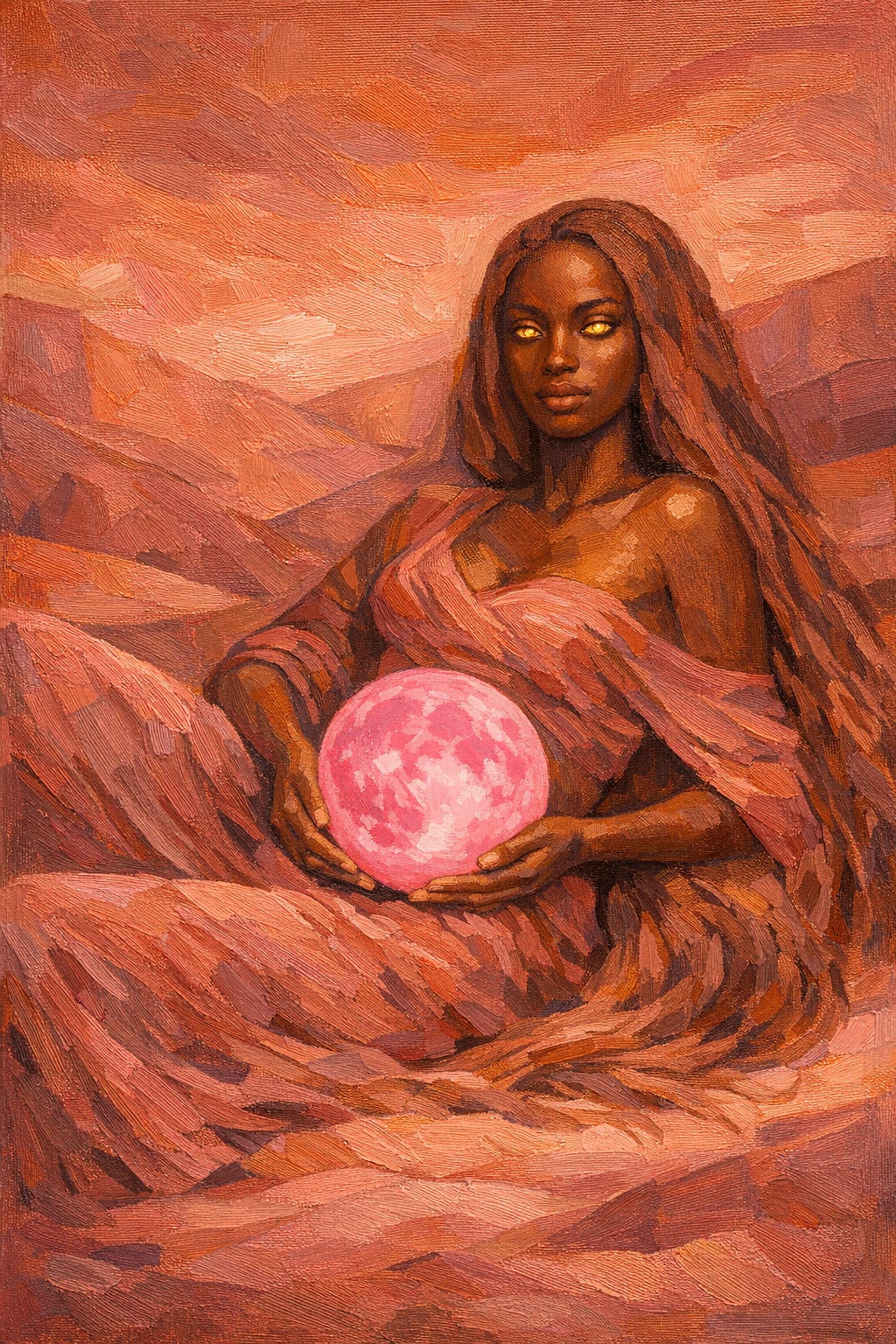
Soluna M’bare Goddess of Interdependence.
She is the breath between refusal and return. The one who embodies the sun and offers the moon. She is body and cosmos, silence and uprising. She is not worshipped. She is remembered. She is not above. She is among.
She rises when we pause. She glows when we choose each other. She is the goddess of the world we are already building in quiet corners and collective refusals.
She is the rhythm of light and of the people.
She is the one who reminds us:
We belong to each other.
We always have.
Prayer to Soluna M’bare on Interdependence Day
For the Peace Bread Offering Ceremony
Soluna M’bare,
Sun‑and‑Moon of the People,
Keeper of the rhythm that outlives empire,
We gather in your light.
We bring what our hands have made,
what our hearts have carried,
what our ancestors whispered into our bones.
We offer this Peace Bread
as a promise to feed one another,
to remember one another,
to rise together.
Soluna M’bare,
hold us in the glow of the Pink Moon.
Teach us the courage of the pause,
the power of the gentle “no,”
the strength that grows when we choose each other
over fear, over isolation, over domination.
Let this day remind us
where we come from,
what the old world demanded of us,
and what we now reach toward.
Let it show us, again and again,
that the world keeps turning
even as we step back from empire
and return to ourselves and each other.
Bless the hands that knead,
the mouths that speak truth,
the bodies that rest,
the communities that refuse to abandon one another.
May this bread nourish our courage.
May this moon illuminate our path.
May this pause awaken our power.
Soluna M’bare,
guide us toward the world we are already making—
a world woven, not ruled;
shared, not seized;
remembered, not forgotten.
And let this be our vow:
We rise by choosing each other.
We rise by choosing each other.
We rise by choosing each other.